Health Is the First Pillar of Financial Freedom: Build Health and Wealth Together
A DS Wealth Advisors framework connecting health, earning capacity, discipline, healthspan, financial protection and the ability to enjoy wealth.
By Dheeraj Kumar Singh•July 24, 2026•20 min read
DS Wealth Advisors • Life Portfolio Series
Health Is the First Pillar of Financial Freedom
Build health and wealth together—because money can finance life, but health allows you to participate in it.
Build a life in which financial progress and physical capability strengthen each other.
Most financial plans begin with income, saving, investing and retirement. At DS Wealth Advisors, we believe that sequence begins one step too late. Before income comes the ability to work. Before compounding comes the discipline to act consistently. Before retirement comes the physical and mental capacity to enjoy the life for which the corpus was created.
Our central belief: Protect the person before optimising the portfolio. Health is productive capital. Insurance is defensive capital. Investments are compounding capital. Time is the non-renewable capital that determines whether any of them can be enjoyed.
The Life-Portfolio Principle
Health creates the capacity to earn. Wealth creates protection and choice. Time determines whether both can be enjoyed.
Health + WealthOne integrated strategy—not two competing goals
## Before You Calculate Your Retirement Corpus, Pause
You may know your monthly salary, annual CTC, net worth, home-loan balance, portfolio return and retirement target. But can you answer these questions with the same confidence?
EnergyDo you wake with usable energy, or are you merely recovering enough to repeat yesterday?
MobilityCan you climb stairs, walk comfortably and participate actively in ordinary life?
RecoveryAre sleep and rest protected—or sacrificed whenever work becomes demanding?
StressHas pressure become so normal that you no longer recognise its effect?
MovementIs your working day physically active, or only economically productive?
FutureDoes your retirement plan assume a level of health your current routine may not support?
These are not simply fitness questions. They concern human capital, earning capacity, family resilience, medical-expense risk, retirement planning and quality of life. A person may diversify investments and insure valuable assets while neglecting the only asset responsible for earning, managing and enjoying everything else: the person.
Financial freedom without health freedom is incomplete freedom.
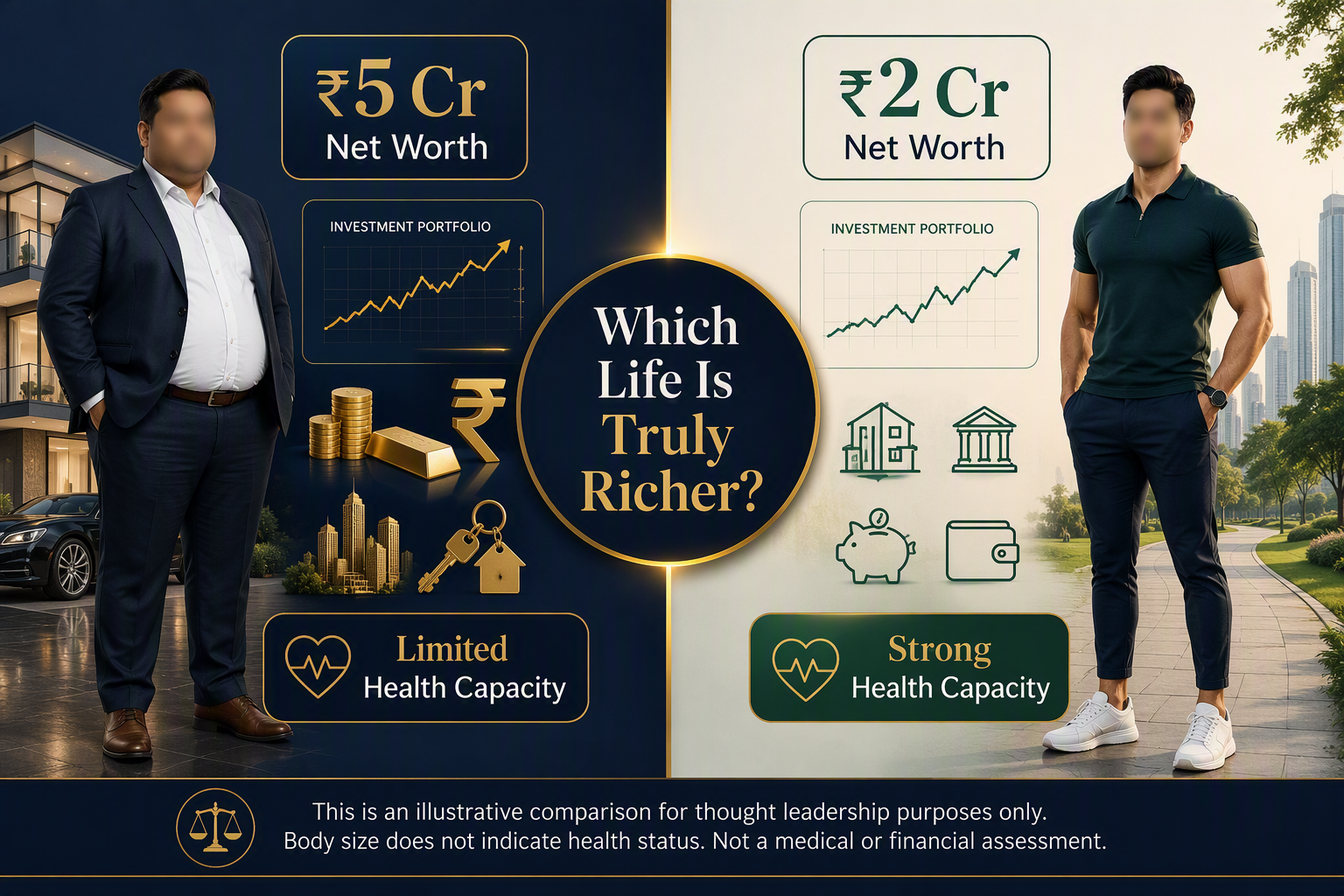
## A ₹5 Crore Net Worth or a ₹2 Crore Life Portfolio?
An illustrative thought experiment: body size alone does not establish health, and financial net worth alone does not establish quality of life. The comparison asks readers to evaluate money, capability, time and well-being together.
Consider two fictional 45-year-old professionals. These are illustrative examples, not medical or financial assessments.
Person A: ₹5 crore net worthPerson A owns substantial financial assets, but daily movement is limited, energy is low, work stress is unmanaged and meaningful experiences are repeatedly postponed. The ₹5 crore balance sheet is financially strong, but the life portfolio is exposed.
Person B: ₹2 crore net worthPerson B has lower financial net worth but maintains regular movement, functional fitness, appropriate recovery, family time, emergency liquidity and disciplined long-term investing. The balance sheet is smaller, while the ability to participate in life is stronger.
The correct conclusionThe lesson is not that ₹2 crore is always better than ₹5 crore, or that appearance proves health. The ideal outcome is to protect health while continuing to build financial wealth—without using either person as a moral judgment.
The question is not, “Which person is worth more?” Human worth cannot be reduced to a balance sheet or body shape. The better question is:
Which life has the stronger combination of financial security, health capacity, time freedom and ability to enjoy wealth?
If Person A improves health while preserving financial strength, that may be the strongest combined outcome. If Person B continues protecting health and compounds ₹2 crore responsibly, that life portfolio may become stronger over time. The purpose of the comparison is therefore not to choose obesity versus fitness or ₹5 crore versus ₹2 crore. It is to expose the weakness of measuring success through net worth alone.
## The Six Capitals of a Rich Life
Net worth—assets minus liabilities—is essential, but it is not a complete description of wealth. A genuinely rich life depends on six connected forms of capital.
1. Health capitalPhysical capacity, mental well-being, mobility, energy and functional independence.
2. Human capitalKnowledge, judgement, professional experience, networks and earning ability.
3. Financial capitalSavings, investments, insurance, property and dependable cash flow.
4. Time capitalThe remaining years—especially healthy years—available to create and enjoy value.
5. Relationship capitalFamily, friendships, community and reliable support during difficult periods.
6. Purpose capitalThe personal answer to a fundamental question: what is all this money ultimately for?
The objective should not be to maximise one form of capital while silently depleting the others. A larger financial portfolio cannot fully replace lost time, damaged relationships or reduced physical capacity. The better objective is **integrated capital growth**.
## The Strategic Error: Wealth Now, Health Later
Many ambitious professionals divide life into two imagined phases.
### Phase One: Build wealth
Work longer, earn more, accept constant stress, compromise sleep, remain seated, postpone exercise and delay meaningful experiences.
### Phase Two: Become healthy and enjoy wealth
Exercise after the promotion. Sleep after the project. Stop smoking after the stressful period. Travel after retirement. Spend meaningful time with family after reaching a target corpus.
The defect in this strategy: the health required for Phase Two may be consumed during Phase One.
Ambition has no natural finish line. After one promotion comes another. After ₹1 crore comes ₹5 crore. After one business milestone comes a larger target. If health is scheduled only after success, health may never receive its turn.
“Wealth first, health later” is not sequencing. It is concentration risk.
## The Complete Financial-Freedom Equation
The conventional equation—income, saving, investing, compounding, freedom—misses its foundation. When health weakens, attendance, focus, productivity, career continuity, saving capacity, debt repayment and family responsibilities can all become harder.
For many working professionals, the greatest economic asset is not the current portfolio. It is the present value of future income. Protecting health is therefore not separate from financial planning; it is a form of protecting future earning capacity.
## Health and Wealth Obey Similar Rules
Wealth creation
Health creation
Shared principle
Regular investing
Regular movement and training
Consistency
Controlled spending
Thoughtful nutrition and habits
Discipline
Emergency liquidity
Sleep, recovery and support
Resilience
Portfolio review
Appropriate health assessment
Measurement
Avoiding speculation
Avoiding extreme shortcuts
Risk control
Long investment horizon
Sustainable lifestyle
Patience
One large investment rarely creates financial freedom. One punishing workout rarely creates fitness. Both are built through repeated decisions that look ordinary in isolation.
Negative habits compound too: prolonged sitting, unmanaged stress, inadequate sleep, smoking, excessive alcohol, irregular eating and repeatedly postponing health needs. No single day appears decisive. The risk lives in the pattern.
Markets compound money. Habits compound health. Time magnifies both.
## My Decision at 33: Why I Chose Fitness and Six-Pack Abs
At 33, I decided that I did not want to measure progress only through salary, designation, net worth or portfolio value. I wanted to become physically fitter and pursue the personal goal of developing six-pack abs.
The goal is partly aesthetic, and there is no reason to pretend otherwise. Improved physical appearance can influence personal presence and confidence. But appearance is not the complete reason.
For me, the goal represents:
DisciplineDoing what the process requires when motivation is absent.
Self-respectValuing the body that makes every professional goal possible.
ConsistencyAllowing small actions to compound over months and years.
ConfidenceCreating evidence that a difficult personal promise can be kept.
CapabilityBecoming stronger and more functional while growing older.
BalanceBuilding career, money and health without sacrificing one completely.
I regularly write about financial compounding. Fitness follows a similar logic. One workout changes little. One controlled meal changes little. One night of good recovery changes little. Repeated over time, those ordinary decisions can produce meaningful change.
I do not want to spend my most productive years accumulating wealth while silently allowing my health to deteriorate. I want the energy to work, the clarity to make responsible decisions, the confidence to lead and the physical capacity to enjoy what I build.
My commitment at 33: I will not treat my body as an expendable asset while building my career and wealth.
Visible abdominal definition is my personal target, not a universal definition of health. A person can be healthy, capable, disciplined and successful without visible abs. Genetics, medical conditions, body composition, age and circumstances differ. The universal objective is not six-pack abs; it is to give health the place its importance deserves.
## Why Do People Ignore Health While Chasing Money?
### Immediate rewards overpower distant consequences
Salary, promotion, profit and portfolio value are visible today. Health deterioration may be gradual. The professional reward arrives immediately; the possible consequence appears uncertain and distant.
### Society celebrates visible success
A title, car, house or business valuation attracts attention. Adequate sleep, mobility, emotional stability and healthy clinical indicators are quieter achievements.
### Busyness is mistaken for importance
A calendar filled with meetings may look impressive. Permanent availability may look like leadership. But occupied hours are not automatically valuable output, and productivity is not automatically sustainable.
### Modern work removes ordinary movement
A professional may sit while commuting, sit while working, sit in meetings and sit again at home. The person remains economically active but physically inactive.
### Stress normalises harmful coping patterns
Smoking, alcohol, emotional eating, endless scrolling, irregular sleep or constant work may become coping mechanisms. These behaviours should not be moralised; addiction and mental-health challenges are complex and may require qualified support.
### “Later” keeps moving
People assume health can be repaired after the next deadline. Yet money may be earned again and markets may recover; time only moves in one direction.
## The Desk-Job Paradox
The risk can look like productivity
A laptop, reports, client calls, investment analysis and late-night responses can produce income while reducing movement, recovery and social connection. A smartwatch or occasional workout does not by itself repair a lifestyle built around continuous sitting and permanent availability.
A sustainable work system may include appropriate movement, genuine breaks, protected recovery, sensible boundaries and qualified help for smoking or other harmful coping behaviours. The aim is not perfection. It is to stop professional urgency from permanently displacing health.
## A Global Warning: Income Does Not Automatically Create Health
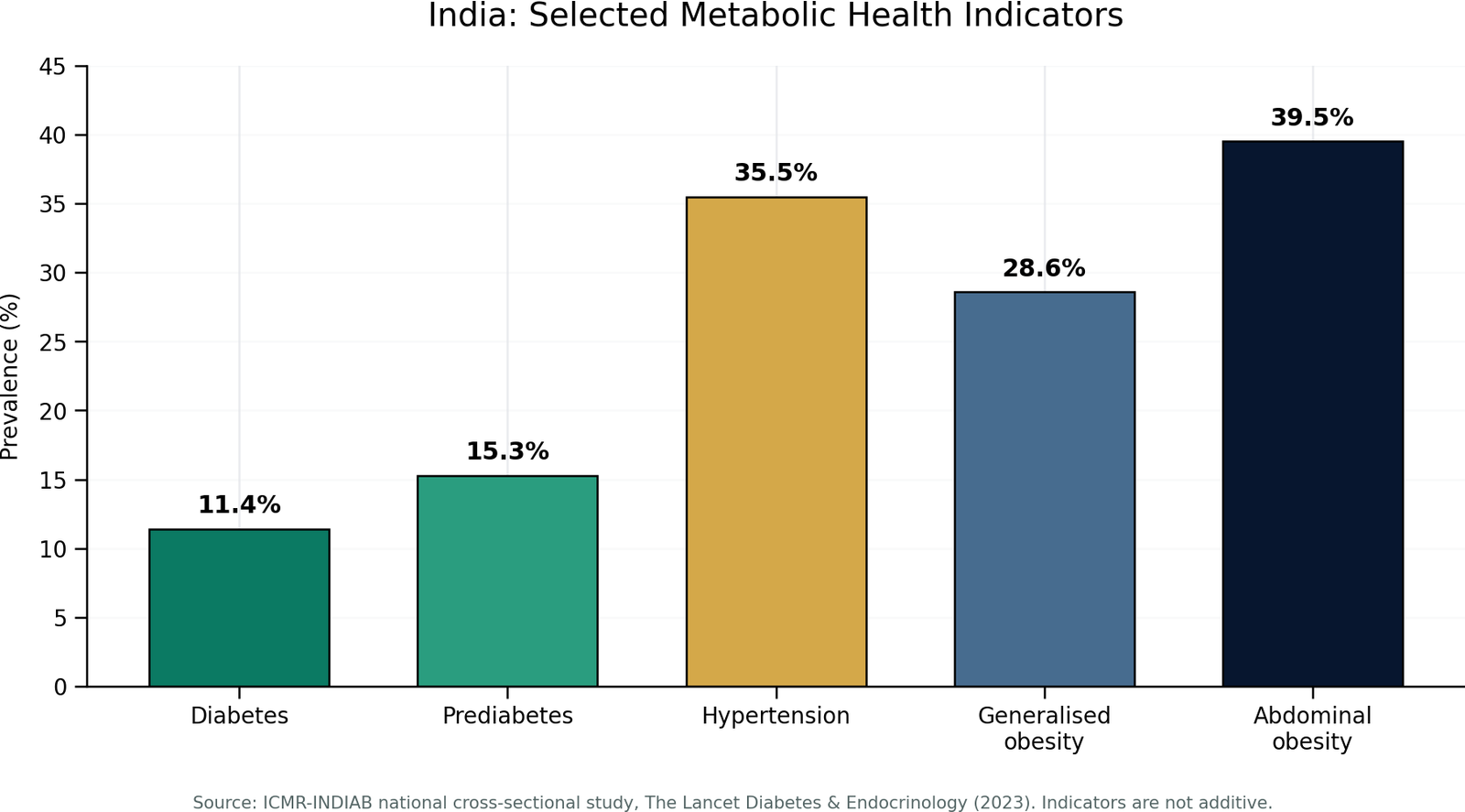
Lifestyle-related and metabolic risks exist across developed and developing economies. Public-health reporting in the United States has highlighted a large burden of diabetes and prediabetes. England's national health survey has reported concerns involving obesity, inactivity, smoking, raised cholesterol and longstanding illness. India's ICMR-INDIAB research has reported significant prevalence of diabetes, prediabetes, hypertension, generalised obesity, abdominal obesity and dyslipidaemia.
These indicators should not be used to create a simplistic country ranking because source years, definitions and populations differ. The strategic lesson is clear: economic development, higher income and advanced technology do not automatically produce good health.
India health snapshot: selected ICMR-INDIAB indicators. The measures describe different conditions and should not be added together or used as a direct country ranking.
## Lifespan Is Not Healthspan
Lifespan measures the years lived. Healthspan concerns the years lived with relatively good health, capability and independence.
Japan is frequently admired for longevity, but total life expectancy and healthy life expectancy are not identical. The gap matters financially because a longer life may require a larger retirement corpus, healthcare liquidity, caregiving support, age-friendly housing and clear succession arrangements.
Retirement planning needs two questions
Lifespan question: Will my money last for as long as I live?
Healthspan question: Will my health allow me to use my time, money and independence meaningfully?
The objective should not be merely to live longer. It should be to preserve the ability to participate meaningfully for as many years as reasonably possible.
## Extraordinary Wealth Cannot Remove Human Vulnerability
Public examples must be treated respectfully. Illness is not a personal failure, and wealth does not make anyone responsible for a medical outcome.
Steve Jobs built extraordinary economic and technological value yet died at 56 after living with a pancreatic neuroendocrine tumour. Gerald Cavendish Grosvenor, one of Britain's wealthiest landowners, died at 64 after a heart attack. Hiroshi Yamauchi transformed Nintendo into a global business and died at 85 from pneumonia. Zuo Hui built a major Chinese property-services platform and died at 50 after a reported worsening of illness.
The lesson is not that money is useless. Wealth can fund care, comfort, assistance and dignity. The narrower lesson is that wealth cannot guarantee recovery, health or unlimited time.
## Medical Bills Can Reverse Years of Progress
A family may spend decades building retirement savings, an education fund, deposits, investments, property or business reserves. A major medical event can redirect those resources rapidly.
The impact is wider than the hospital invoice:
- Income may reduce while expenses rise.
- A caregiver may reduce working hours.
- Long-term investments may be sold at an unfavourable time.
- Education or retirement goals may be delayed.
- Borrowing may create interest costs.
- Recovery, travel and non-covered items may require additional liquidity.
A health event can therefore become a liquidity, income, debt, retirement and family-governance crisis at the same time.
## Insurance: Create Curiosity, Not False Confidence
This article is not a health-insurance or term-insurance buying guide; each deserves a separate detailed article. But no health-and-wealth framework is complete without introducing their purpose.
Health insuranceMay help protect accumulated savings against eligible medical expenses, subject to policy terms, exclusions, limits, waiting periods and co-payments.
Term insuranceMay help protect dependants when an income-producing person's future income disappears permanently.
Emergency liquidityHelps meet deductibles, excluded expenses, immediate deposits and household costs during recovery.
The essential health-insurance question is not merely, “Do I have a policy?” It is:
> **If a major hospitalisation occurred next month, could my financial plan survive without sacrificing assets created for retirement, education or a home?**
The essential term-insurance question is not, “What is the cheapest premium?” It is:
> **If my income disappeared permanently, how much support would my dependants actually require?**
Health insurance may defend savings. Term insurance may defend dependants. Neither replaces the need to protect health itself.
## Money Is Not Meaningless During Illness
“Without health, money is only paper” is emotionally powerful but needs balance. Money remains extremely important during illness. It can provide treatment, care, rehabilitation, accessibility, transportation, nutrition, income support, dignity and choice.
The mature conclusion is:
Without health, money may lose much of its power to create experiences. Without financial preparedness, a health crisis can become far more damaging.
## The Healthy-and-Wealthy Self-Assessment
Give yourself **2 points for Usually**, **1 for Sometimes**, and **0 for Rarely or Never**.
Health & energy Movement, sleep, recovery, appropriate health attention, functional capability and constructive stress management.
Behaviour & discipline Consistency, honest tracking, restarting after setbacks and avoiding harmful coping mechanisms.
Wealth & protection Regular investing, emergency liquidity, health protection, dependant protection and accessible records.
Time & purpose Family time, present enjoyment, meaningful goals, work boundaries and a personal definition of “enough”.
Use these 24 statements:
1. I make time for appropriate physical activity.
2. I protect adequate sleep and recovery.
3. I do not repeatedly postpone necessary health attention.
4. My working day includes purposeful movement.
5. I have constructive ways to manage pressure.
6. My routine supports capability, not appearance alone.
7. My habits support the future life I claim to want.
8. I remain consistent when motivation declines.
9. I do not depend on harmful coping mechanisms.
10. I restart after a setback.
11. I measure progress honestly.
12. My calendar reflects my priorities.
13. I save and invest consistently.
14. I maintain accessible emergency liquidity.
15. I have reviewed my health protection.
16. My dependants would have support if my income stopped permanently.
17. My retirement plan considers healthcare needs.
18. My family can locate essential financial information.
19. Work does not consume every important part of life.
20. I spend meaningful time with important people.
21. I use an appropriate amount of money to improve life today.
22. I do not postpone every experience until retirement.
23. I know what “enough wealth” means to me.
24. I am building a life—not merely accumulating assets.
A sound base exists, but some priorities may not yet translate into consistent behaviour.
15–26
Financial progress may coexist with significant health, liquidity, protection or time risks.
0–14
Pause and reassess. The strategy may be creating assets while accumulating vulnerability.
This is a reflection tool, not a medical, psychological or personalised financial assessment.
## Your 90-Day Healthy-and-Wealthy Reset
First 7 days Review sitting, sleep and movement. Locate insurance records. Check emergency savings. Identify one postponed health need.
First 30 days Build a sustainable activity routine. Review protection. Organise records. Seek qualified support for harmful coping behaviours where needed.
First 90 days Review health, wealth, time and protection together. Choose one health goal and one financial goal that reinforce each other.
## Five Questions to Confront Honestly
1. **What exactly am I building wealth for?** Does my current lifestyle preserve the ability to experience it?
2. **What am I sacrificing for present income?** Is the sacrifice temporary and intentional—or permanent and uncontrolled?
3. **Does my retirement plan include healthspan?** A calculator may project life to 90, but has the plan considered care and medical liquidity?
4. **Would the household survive interrupted income?** Consider cash, insurance, debt and documentation.
5. **If my wealth rises for ten years but my energy, mobility and relationships decline, will I call that financial progress?**
## Final Perspective: Do Not Become Rich at the Cost of Living Richly
The purpose of financial planning is not to die with the largest possible portfolio. It is to create security during uncertainty, dignity during illness, protection for dependants, freedom from destructive debt, independence in retirement, time for relationships and the capacity for meaningful experiences.
At 33, my fitness and six-pack goal is one expression of this philosophy. The appearance is personal; the principle is universal:
> **Do not postpone becoming healthy until after becoming wealthy.**
A portfolio can be inherited. Property can be transferred. A company can appoint another leader. But nobody else can exercise, recover, participate or live on our behalf.
MoneyStored purchasing power
HealthLiving power
InsuranceFinancial defence
Before leaving, examine your calendar, sleep, daily movement, work culture, coping habits, bank statement, investments, protection and family time. Together, they reveal your real priorities more accurately than your intentions.
Am I building enough wealth to protect my life—and enough health to enjoy my wealth?
Do not target healthy **or** wealthy.
# **Target healthy and wealthy together.**
Build both. Protect both. Create enough time to enjoy both.
### Explore the Next Guides
**Coming next:** Complete Health Insurance Planning Guide for India
**Coming next:** How Much Term Insurance Do You Need in India?
Build a life portfolio—not merely an investment portfolio. A complete strategy should align emergency liquidity, insurance, investments, retirement planning and family goals with the life those resources are intended to protect.
[Connect with DS Wealth Advisors](https://wa.me/919315731078?text=Hi%20DS%20Wealth%20Advisors%2C%20I%20want%20to%20build%20a%20healthy%20and%20wealthy%20financial%20plan)
### Disclaimer
This article is for general education and awareness only. It is not personalised medical, fitness, investment, insurance, tax or legal advice. Health needs and insurance suitability differ across individuals and families. Consult qualified healthcare and fitness professionals before beginning a demanding programme, and appropriately authorised professionals before acting on financial, insurance, tax or legal matters. Insurance benefits are subject to underwriting, policy terms, exclusions, waiting periods, deductibles, co-payments, sub-limits and applicable regulations. Public examples are included only to illustrate the limits of financial wealth; illness is not a personal failure and no medical outcome should be attributed solely to lifestyle or financial decisions.
Rate this article’s usefulness
Your rating helps us improve future DS Wealth Advisors research.